Perspectives On Print Lectures
I have really enjoyed our lectures with Paul Coldwell, his brilliant selections of print really cover the breadth of the medium as a whole and have exposed me to work and techniques that would have never have been brought to my attention before. I went further and bought Paul Coldwell’s book, ‘Perspectives on Contemporary Printmaking’ and have enjoyed carrying on my research through this. It’s also really amazing to hear Paul’s stories of working with legendary artists such as Paula Rego and it’s a privilege to have such an experienced and learned printmaker teaching us. One of the most interesting things that I’ve taken from Paul Coldwell’s lectures is his discussion of etching as a technique, Paul stated that “Etching is made up by the drawing, and a collaboration with the acid; the art of intaglio is in the acid.”. This idea is something that I have certainly taken forward within my own work, especially in my waterfall plates, where I as an artist do not have much control over the outcome of the piece, but instead work with the natural elements at my disposal and collaborate with the nature of the scenes I depict, as well as with the natural chemical processes created by the acid. It’s really interesting to also see Paul’s work, I would have imagined, after editioning for artists such as Rego, that Paul’s work would take on a much more traditional appearance, but it’s really inspiring that he constantly utilises new technologies in his work, such as laser cut and digitally edited relief prints. Another really important thing that Paul told us in our first lecture, and something that I have consistently done since the start of the course, is go and see the works in person, especially in print where there is such a physicality to every piece, and often quite a dramatic scale, whether super large or really tiny. A great example of this is when me and my classmate Boris went to see the Lucian Freud exhibition in the V&A Museum, and were delighted to see that in amongst Freud’s work, was Rembrandt Von Rijn’s, ‘Self portrait in a velvet cap with plume’, something we had both seen many times before online, but were shocked that the print was tiny, measuring 14.2x11cm.
Mark Fairnington Lecture
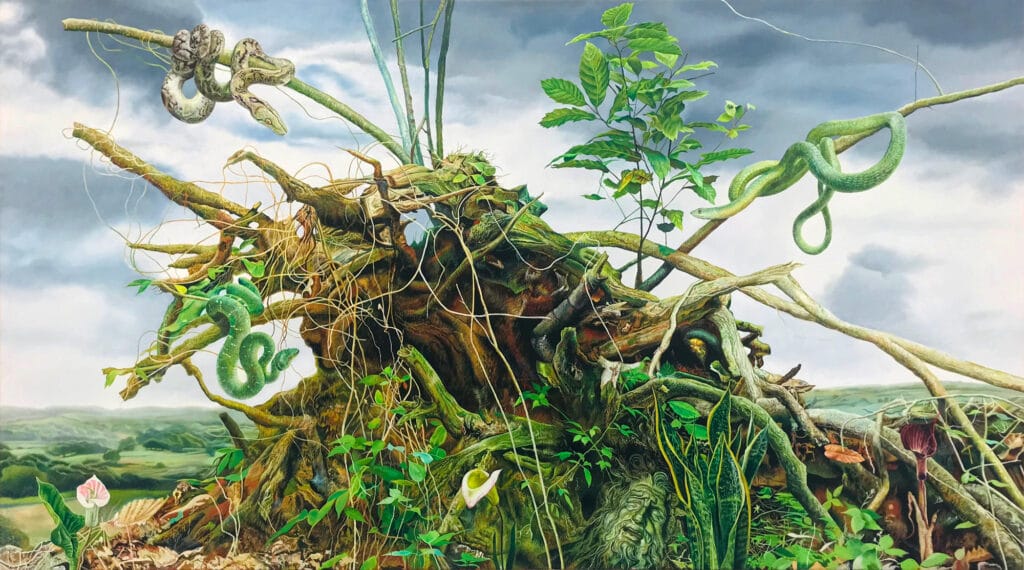
I really enjoyed a lecture presented by Mark Fairnington on realism. Fairnington’s work itself was fantastic, hyper-realistic to the point of almost surreal, his vibrant, unnatural use of colour really stood at odds with the obsessive detail utilised in his large-scale paintings. This notion led onto his discussion of realism, and its truth. Is hyper-realism falsehoods masquerading as truths, it is ‘speculated fiction’ presenting itself as observed fact. Fairnington quoted fantastic critical debates, such as ‘The Vast Extent of Seeing and Not Seeing Further”, by Lavinia Greenlaw that really helped in my own critical reflection around my own work. Fairnington’s other work on taxidermy was also really interesting. I drew parallels between his own discussion of stilling life in taxidermy to my work on the landscape and stilling nature, Fairnington had a fantastic selection of references that were beautifully worded within his lecture and quoted Rachel Poliquin’s, ‘The Breathless Zoo’, stating “[taxidermy] is the conquest of mortality over a semblance of life in death”- which I believe is just a beautiful way of articulating the point. My favourite part of Fairnington’s lecture was towards the end when he showed us some of his more recent works, depicting tangled and knotted living forms, bursting with various forms of exotic life. These sottobusco paintings used the undergrowth as a figure within the painting, and this is something I tried to take into my own work, with the stone cairns in my mono print depicting the summit of Brown Wardle Hill. Fairnington’s subsequent discussion of his own recent struggle with cancer, and his acknowledgement of these paintings as subconscious self portraits was something that I found really profound and touching.
‘Sustaining a Long Career in The Arts’- James Reynolds
James Reynolds’ lecture on sustaining a long and fruitful art career was really helpful in thinking about the future of my work. James began by discussing how to value your practice, he broke this down into four steps, 1. Valuing your art, 2. Valuing yourself, 3. Valuing others, and finally 4. What tools can we use to build value? Reynolds’ discussion here was really helpful and accessible. James then broke down the difference between value and price. While price is something followed by a ‘£’ sign stuck on your work, value is an accumulation of cultural relevance that builds with time, it may vary with context and time but remains stable, the most important thing he then followed with was that you can actively work to build value, and likely already have, but you can’t build price. This is something I have always grappled with in my own work so it was comforting to be told that just because I’m not selling anything for a lot of money, doesn’t mean my work doesn’t have value. James broke down what a sustainable and long-lasting art practice may be built from. He said that a sustainable practice may be; Experientially unique, critically embraced, creatively satisfying, can be sustainably evolved and financially viable. Another important thing that I took away from this lecture was the concept of ‘Autotheory’, a biased and experiential theoretical thinking practice. Authotheory is lived in and transgresses standard theory, stitching together criticality and life. This was also a really interesting thing to learn about, as I believe that a lot of my research is autotheoretical, using experience and place to inform my critical thinking. James finished with a very helpful list of websites and organisations where we can find commissions, community projects, cheap studio spaces, etc. I think the most important thing I took away from this lecture was in regards to pricing work, James said that if someone was to ask how long a piece of work took you to make, your answer shouldn’t be a timeframe, instead the best reply is, “my whole life”, and this is something I’ve repeated to many others since.
 Ollie Norris