In a lecture with Fay Ballard, she poignantly stated, “A work comes out of the need to make an image.”. This reasoning behind work, or ‘pre-sense’[i] is something that I have recently been grappling with, my work is and has always been about a reverence to something greater, and it is important in this stage of the course that I situate my practice within the context of my late father. In this essay I will discuss the psychoanalytical and ‘reparative’ elements behind my work, as well as a discussion of certain elements of a landscape and their relationship with melancholy, grief and loss. Finally, I will discuss time and its relationship to landscape, and us as observers within it.
My father was an avid wildlife enthusiast and instilled within me the joys of being within nature, since his passing, my relationship with him has had to take on another form, and this is through being in and making work about the places that still contain fragments of him and our time together. My aim in my work is to try and confront these very abstract and complex feelings through a preverbal language, artwork. Hanna Segal discusses this need to create art as a reparative process in her book, ‘Dream Phantasy and Art’. Segal discusses Proust’s major work, ‘A la Recherche du Temps Perdu’ and quotes, “I had to recapture that from the shade that which I had felt, to reconvert it into its psychic equivalent. But the way to do it, the only one I could see, what was it- but to create a work of art?”[ii]. On this Segal suggests that there is a “direct link between this need for reparation and the origin of the creative impulse.”[iii]. This is an opinion that resonates with me and my own work. I’ve always had difficulties discussing my very complicated feelings towards the loss of my father, Patricia Townsend discusses the difficulty of “describing an experience that does not easily lend itself to everyday language.”[iv], what would be the purpose of creating the work I make if it could be easily articulated in words? I believe that my work displays various qualities of my complex feelings, I believe that there is a beauty and a hope in the work, that is balanced by an intense darkness and brutality. I believe the purpose in my work, is to try and create an object to act as an avatar for my feelings, and to “[embody] and [symbolise]… in the recipient a certain kind of archaic emotion of a preverbal kind.”[v]. Similarly, Freud, in his 1914 essay on Michelangelo’s ‘Moses’, states that “[the artist] aims… to awaken in us the same emotional attitude, the same mental constellation that produces in him the impetus to create.”[vi]. It is important for this reparative work to take place through the creation of the artwork, as an object that can be imbued with intense emotion. These feelings that are too difficult to express in a normal verbal or emotional manner “can only be dealt with through expulsion”[vii] There is a conscious act of rebuilding after this expulsion, however, to reinstate and compartmentalise the trauma within the psyche. Segal discusses one of her patients who, after the loss of her mother, had vivid dreams of reassembling her fractured family by assembling a jigsaw portrait of them together as a whole[viii]. This patient found solace in this loss, by creating a book, bringing together “various elements , symbolising the bringing together of fragments of her mother and family.”[ix] I had already settled on my idea of creating a landscape that would act as a portrait of my feelings towards the loss of my father, and our shared relationship before reading this, but it’s interesting to note that my own reparative form of creating artwork is mirrored by that of Segal’s patient, bringing together pieces of a fractured whole to reinstate my father within myself.
I would now like to move onto the notion of landscape as a subject, specifically in my work, the light and darkness that inhabit them, and the binary of the land, horizon relationship. The relationship between sea, land and sky is an ancient one and the notion of the horizon within landscape artworks and specifically in the flatness of the East Anglian marshlands, where a lot of my work is situated highlights the liminality and the connection to divinity these places hold for me. Ralph Waldo Emerson, in his essay, Nature, sums up my views around the horizon perfectly in one sentence, “In every landscape, the point of astonishment is the meeting of the sky and the earth.”[x]. The horizon is so beautifully profound to me as it illustrates the untouchable and seemingly intangible boundary between the Earth and the heavens, Didier Maleuvre suggests that the horizon is “the paradoxical experience of a limit without an end.”[xi] The horizon feels like such a concrete presence, a physical line that denotes the edge of sight, and the beginning of the sky, but it is completely intangible, it is not a point that can be visited or reached, yet it is there and always remains there, the end of the rainbow. Within my own work, specifically situated in place and the relationship between me and my father, this horizon acts as the boundary between us. Sat on the bench on the Stiffkey Saltmarsh, this horribly, but beautifully scarred landscape that I inhabit, is separated from the incandescent heavens where I feel his presence. Therefore, the clouds in my work hold a very important significance to me, this profound and celestial, but importantly, unreachable world, that acts as a physical boundary between the worlds me and my father inhabit.
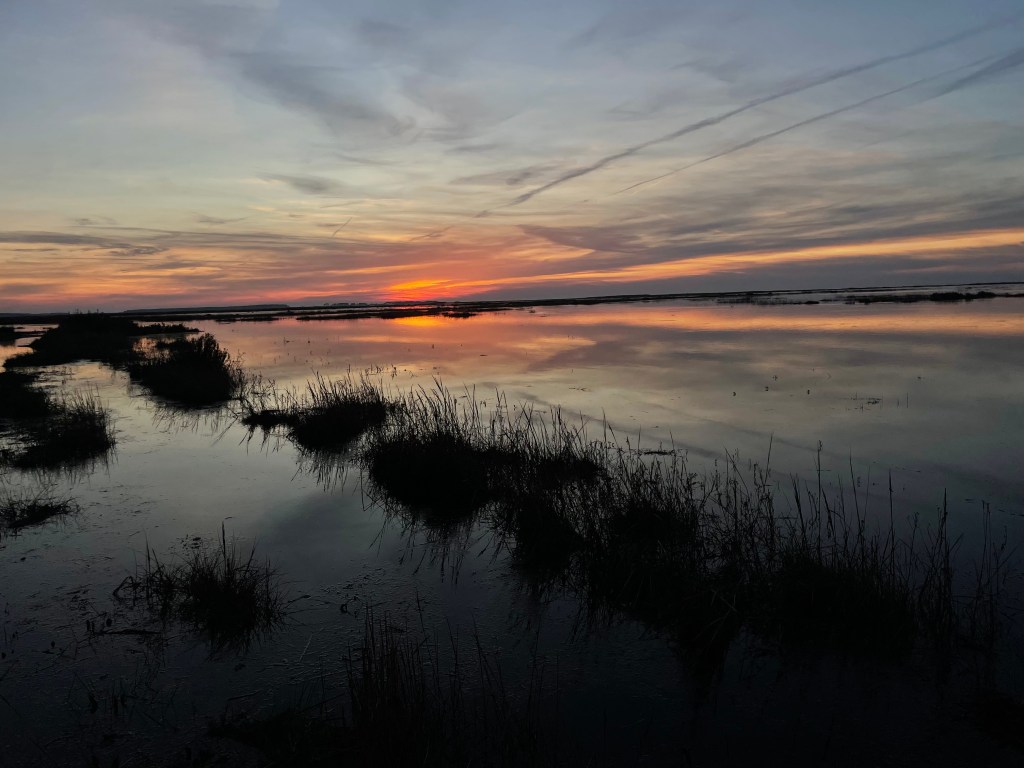
The relationship between the liminal horizon and the similarly liminal aspects of light, specifically dusk, are also of interest to me. Peter Davidson in his beautiful book, ‘The Last of the Light, About Twilight’, has put forward a lovely concept, “Like twilight, the whole human condition is thus conceived as occupying a halfway point between a greater light and a greater darkness.”[xii] The dusk represents the transitional point of something beautiful, mutating into something terrifying, while the dawn represents the opposite, in perpetual motion, one after the other. Ruskin, observes this in J.M.W Turner’s painting, ‘The Fighting Temeraire’, “under the blazing veil of vaulted fire, which lights [the Temeraire] on her last path, there is a blue, deep, desolate hollow of darkness, out of which you can hear the voice of the night wind, and the dull bloom of the disturbed sea; because the cold, deadly shadows of the twilight are gathering.”[xiii]. In my work there is an ambiguity between the dusk and the dawn, which I myself am not sure on the notion I prefer. Looking over the marshes at dusk instils me with an awe-filled terror, the pitch-blackness encroaches, while the tide creeps up, eager to trap you on a shrinking island, the bared fangs of the North Sea’s waves gathering like wolves to feast. While the dawn becomes the antithesis, the shadows of the night are vanquished by a glowing and fiery sun, eager to fill the world with beauty and light. I’m not sure if this makes my work hopeful, or hopeless, mirroring my feelings towards the loss of my dad.

Davidson suggests that a trope of many paintings that contain this dying of the light, is a “sense of belatedness, not only of late arrival at a place…but of coming to a place after a lapse of time when circumstances have changed.”[xiv] I feel that this really echoes my own visits to Healey Dell and Norfolk, places that were often filled with pieces of my father, with us swimming in the sea, or photographing the dipper in the river, that are now filled with a bitterness and a grief; “with the sense of belatedness goes a sense of devouring failure, formless grief, unfinished and unfinishable business.”[xv]. Although I agree with Davidson’s notion to an extent, it offers a very defeatist sense of finality. Within my own practice, I prefer to see this light as ambiguous, I believe that although there is a huge sense of finality in the death of my father, there is also a reparative growth, new memories to be made, other happiness can inhabit these spaces, even if they feel so devoid of it now. Rodin states that this is the role of a great artist, to “get hold of this ugliness”, to “[transfigure] it”, to make “it into beauty”[xvi]. While I don’t believe in the binary of ‘ugliness’ and ‘beauty’, I do believe in my purpose to transform this grief, regret and loss into a new tangible, and repaired form through the making of the artwork.
Another part of the landscape that I have identified within my own work is a sense of the passage of time. Time is obviously something that is prevalent in my relationship with my father, the time from diagnosis to death, the short time we spent together, the stretching of time that obliterates memory and forces distance between us. But time within nature is experienced completely differently. In my writing on location in Healey Dell, I discuss the passage of time and my father’s need to visit these natural spaces where time behaves differently. I write: “I think of my Dad now, and his defiance against his illness, and his desire to be somewhere where time stretches out, the last 1000 years have not changed this place like it has the rest of the world, and maybe for him here, the encroaching mortality stretched for a moment, still easing its way towards him but slower”. Landscapes are often referred to as symbols of change, through erosion, decay, birth and rebirth, however, I would posit that landscapes can also a symbol of the lengthening of time, and of an almost unchanging form. Rocks may be eroded, but this happens over the course of thousands of years, without the element of human interference, landscapes experience a slower perception of time than we do. In his seminal work, ‘Basin and Range’, John McPhee suggests that “A million years is a short time – the shortest worth messing with for most problems. You begin tuning your mind to a time scale that is the planet’s time scale.”[xvii]. Within my own work, this sense of time is important. If time is stilled or slowed, then we can linger with the presence of those lost within these spaces, they can represent these fleeting memories of occupying a natural space with someone. For my father, I believe that this slowing down of time was a refuge, and a reason why he found so much solace in these landscapes. Perhaps if the time here slowed, then that would give him a moment when he wasn’t on a swift collision course with his own mortality. Maybe then, the cancer within him would slow and cease its onslaught.
[i] Townsend, P. (2019) Creative States of Mind.
[ii] Segal, H. (2015) Dream, phantasy and art. p. 86, London: Routledge.
[iii] Segal, H. (2015) Dream, phantasy and art. p. 86, London: Routledge.
[iv] Segal, H. (2015) Dream, phantasy and art. p. 12, London: Routledge.
[v] Segal, H. (2015) Dream, phantasy and art. p. 81, London: Routledge.
[vi] Freud, S. (2016) Der Moses Des Michelangelo. p.2, Createspace Independent Publishing Platform.
[vii] Segal, H. (2015) Dream, phantasy and art. p. 51, London: Routledge.
[viii] Segal, H. (2015) Dream, phantasy and art. p. 38, London: Routledge.
[ix] Segal, H. (2015) Dream, phantasy and art. p. 47, London: Routledge.
[x] Ralph Waldo Emerson (2019) Nature :: Essays: second Series – Ralph Waldo Emerson, Ralph Waldo Emerson. Emerson Central. Available at: https://emersoncentral.com/texts/essays-second-series/nature/.
[xi] Maleuvre, D. () The horizon : a history of our infinite longing. Berkeley: University of California Press.
[xii] Davidson, P. (2015) The Last of the Light. p.10, Reaktion Books.
[xiii] The Project Gutenberg eBook of Modern Painters, Vol. I, by John Ruskin. p. 153, (no date) http://www.gutenberg.org. Available at: https://www.gutenberg.org/files/29907/29907-h/29907-h.htm.
[xiv] Davidson, P. (2015) The Last of the Light. p.86, Reaktion Books.
[xv] Davidson, P. (2015) The Last of the Light. p.86, Reaktion Books.
[xvi] L’art; entretiens réunis par Paul Gsell : Rodin, Auguste, 1840-1917 : Free Download, Borrow, and Streaming : Internet Archive (2025) Internet Archive. p.46, Available at: https://archive.org/details/lartentretiensr00rodiuoft/page/46/mode/2up (Accessed: 12 May 2025).
[xvii] Mcphee, J. (1969) Basin and range. Washington: United States Print. Office.
 Ollie Norris