Becoming Formless
-The Cloud as a Vessel for Grief, Mourning and Memory-
Throughout this course, I have aimed to create a visual language that reflects something very personal to me, my feelings towards the death of my father. I have explored many different iterations of these emotions to varying success through different media and subjects. However, all seem to fall under the umbrella of landscape, or at least the natural world. The shift in my work from the Earthly landscape, upwards towards the clouds, is one that allowed me to most effectively explore the formless and abstract nature of grief, mourning and the transmutable and changeable aspects of memory. In this essay, I will discuss the cloud as a motif for grief and the work of mourning, as well as looking to the cloud as an abstract and ephemeral form, where grief coalesces and is suspended, making these vessels floating memorials to my father.
As discussed in previous essays, the role of the cloud and Horizon is paramount in my work. Didier Maleuvre has talked of the Horizon as “the paradoxical experience of a limit without an end.” (Maleuvre, 2011)[i]. The Horizon, and the celestial vastness it holds back, illustrates the crux of my work: this unknowable, vast space that lingers above us holds these paradoxical entities. Gaston Bachelard suggests that looking up at the sky is “A subtle moment, a wonderful moment when everything stirs within us… aerial reverie.” (Bachelard 2011) [ii]. It is this very Romantic sentiment of the Sublime and awe that has worked my focus from the ground up to the Heavens. So specifically, how does the nature of the cloud relate to grief and mourning? It is the fluctuation and formlessness that interests me in the cloud. The cloud represents the more liminal aspects of the work of mourning, balancing on the concrete and the abstract; it is both weightless and incomprehensibly heavy, present and absent, endlessly forming and reforming with no real beginning or end. The cloud refuses closure in a perpetual rehearsal of grief.
It would be remiss to talk of the cloud as a symbol of powerful emotion within art without commenting on some of the masters of utilising clouds. I have frequently spoken of J.M.W. Turner and John Constable as among the greatest inspirations in my work. The key difference for me, between the work of Turner and Constable, is the fact that Constable’s work fuses scientific observation with that romantic sentiment of awe and the Sublime, seen below[iii]. He had close links to a newly formed meteorological society, where his images were used as a scientific reference for studying weather patterns. These images, therefore, become studies on the passage of time, weather and the abstract and formless nature of the cloud. While Constable’s images and their empirical ‘truth’ in depicting the cloud as a form is obviously awe-inspiring, it is here where my critique of his work lies. This critique does not concern the aesthetics of his images, but rather their grounding in science and reality. The mezzotinted clouds that I produce do not attempt to be facsimile representations of this ‘truth’; they are fallible and ungrounded, and I attempt to make these forms vessels for my own emotion. Their overt recognisability as a cloud is merely a starting point for the image, and I like that they slowly become their own thing. Turner, in his images, instead chose to surpass the beauty of the clouds and to elevate them into these swirling masses and flashes of light that would not be out of place in a Baroque depiction of Heaven, luminous swirls that threaten to engulf the viewer. I think a lot of the success in Turner’s depiction of the cloud lies in his later mezzotints, such as this depiction of the River Tyne in Newcastle[iv], where his subtle monochrome tonalities seem to evoke this feeling of melancholy and slow dissolution, that may not be as visible in his more chromatic oil paintings and watercolours.

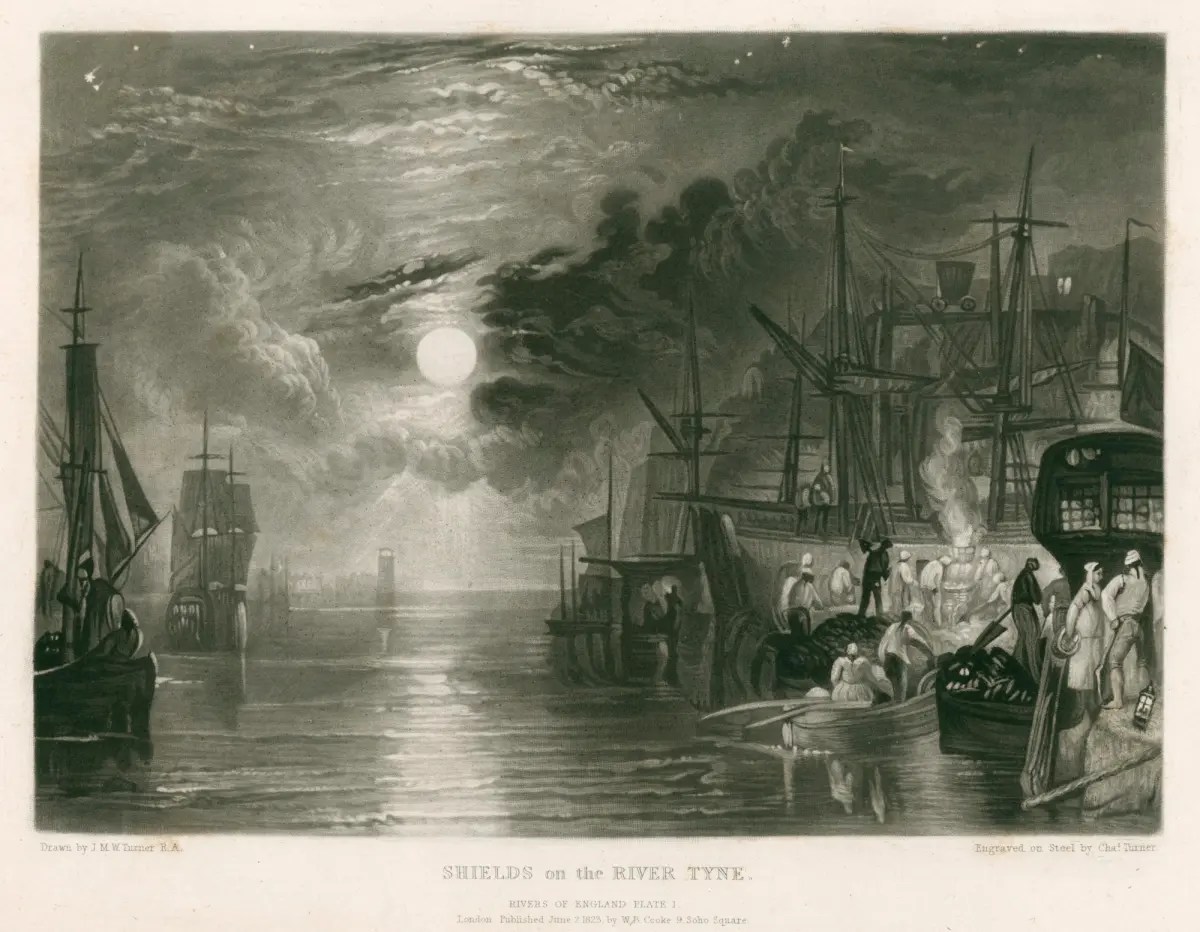
John Constable, ‘Cloud Study: Horizon of Trees’, Oil on Board, (1821), R.A . . J.M.W Turner, ‘Shields, on the River Tyne’, Mezzotint on Paper, (1823), R.A
The motif of the cloud as a symbol of grief and mourning is also prevalent in other forms of non-visual art. One poem that stuck in my mind through the creation of this body of work was the aptly named “Clouds” by the 20th-century poet, Rupert Brooke. The most poignant stanza reads as follows:
They say that the Dead die not, but remain
Near to the rich heirs of their grief and mirth.
I think they ride the calm mid-heaven, as these,
In wise majestic melancholy train,
And watch the moon, and the still-raging seas,
And men, coming and going on the earth. (Brooke, 2019)[v]
Brooke uses the cloud here to symbolise those who have left us, as these entities entirely separate from the tumult of the human world. I especially love his idea of a “wise majestic melancholy train”. This notion is something that I really tried to embed in my series of mezzotints- these lone, melancholy receptacles of grief, swollen in mourning, wrapped in gossamer, vaporous husks. It is obvious to relate the clouds above to ideas of lost souls or spirits detached from their bodies; these hulking masses of wispy vapour do contain that ephemeral notion of that which has passed on. However, I choose to relate these vessels to something more deliberate than aimless bodies floating through the sky; instead, I see them as avatars for emotion. Chiefly in my practice, these emotions are grief and loss.
A further example of this formless idea of memory, and a massive inspiration to me in this project, although not strictly linked to the imagery of clouds, is ‘The Book of Mutter’, by Kate Zambreno. This piece of writing was composed over thirteen years and examines truth, grief and memory in the face of the author’s mother’s death. The book is an unstructured and random set of observations and memories that were recorded as they were confronted, experienced or remembered, leading to the book echoing the formless nature of the ‘grief-cloud’ that I exhibit within my own work. I especially like Zambreno’s cutting recollections of her mother’s memory when she examines photographs. I am very interested in the photograph and its relationship to memory, given its perceived empirical truth and its actual, completely staged performance. I often think back to the Philip Larkin poem, ‘Lines on a Young Lady’s Photograph Album’, with Larkin quoting in a powerful stanza,
“But o, photography! as no art is,
Faithful and disappointing! that records
Dull days as dull, and hold-it smiles as frauds,
And will not censor blemishes
Like washing-lines, and Hall’s-Distemper boards,” (Larkin, 1955)[vi]
This juxtaposition between the ‘faithful’ and ‘disappointing’ elements of photography calls into question the unreliable and formless nature of memory. Zambreno is confronted with a similar conundrum when looking through old photos of her mother, her memory of her Masters Graduation Day, where her mother looks “not beautiful as [she remembers]” but “haggard” and “quite thin”, Zambreno questions if “both memories could be housed inside of [her]?” (Zambreno, 2017)[vii] I think that it is this very notion that relates to my images of clouds and my own portrayal of grief. The photograph becomes its own version of memory; it highlights the complexity and formless nature of remembrance.
We are familiar with the cloud; it is a quiet constant in our lives, an omnipresent sentinel, and we are also familiar with how clouds make us feel. It is no secret that the weather can significantly alter our moods. Overtly, this can be interpreted as the blue, cloudless sky offering a more positive outlook on life, whereas the grey, cloudy one connotes melancholy. However, the British Psychological Society expands on this, suggesting that those hot, cloudless days intensify emotion, be it positive or negative, leading to less cognitive function and concentration. In contrast, the grey cloudy day dulls these more intense feelings, allowing for more introspection: “memory is better on cloudy, rainy days than sunny days” (Harley, 2018)[viii]. One of the biggest reasons to create this body of work was that of memory. I have found that the slow onslaught of time has eroded away at the memory of my father; things are thrown away, photos are taken down, and wedding rings are removed. This memory is not simply just being eroded or eaten away; however, the memory swells like the tide, strikes you with remembrance, then washes other parts away. The mutable nature of the cloud is paramount in exploring this in my own work, and the work of the print allows this memory to become, in some way, concrete, fixing these amorphous shapes in time and defending against loss. Proust likens loss to “a huge cemetery in which on the majority of the tombs the names are effaced but can no longer be read” (Proust, 2016)[ix], but some of these names may still be legible due to the mourning and remembrance by loved ones, that then extends to a memory that lives in the viewer of the artwork, their own memory keeping alive the love between me and my father, just because they have looked at it. I like to view my cloud mezzotints as ‘Souvenirs’, defined by Susan Stewart in her book, On Longing, as “an object arising out of the necessarily insatiable demands of nostalgia” ( Stewart, 1993)[x]. I see these mezzotints not only as recordings of clouds I have seen, but also as souvenirs of emotions and memories of my father, each ‘chiming’ with a personal thought in my head, either through its shape or the process of creating it.
Clouds can also function as concrete and physical forms of ‘memory’ or at least ‘trace’ storage. Olafur Eliasson’s ‘The Weather Project’ [xi] that took over the Tate’s Turbine Hall, was a vast artificial sun that bathed the hall in a warm orange glow, while an artificial mist was pumped into the space. Naturally, this mist would capture and ‘record’ every visitor who occupied the space, through their breath and sweat, logging every viewer who observed the work. The installation thus becomes a living archive of human presence, a vast, ephemeral document of participation, making the very atmosphere itself a site of memory. Real clouds also do this in nature, but on a huge scale. Every bit of moisture on this planet, including the moisture within us, is constantly recycled, evaporating into the sky and forming clouds. Every cloud contains pieces of us and our history, thousands of years of human presence, vacuumed into the aether and sent back to Earth; the real nature of clouds thus becomes vast vessels of human memory. In a more modern sense, ‘The Computational Cloud’ has been used to refer to a huge invisible infrastructure and media highway that spreads across the Earth. Here, the motif of the cloud is still pervasive, a symbol of the abstract and the concrete that metaphorically signifies our contemporary state of infinite digital archiving and remembrance, yet simultaneous forgetting. A key example of this contemporary look at clouds, and a critique of ‘The Computational Cloud’, can be observed. In Trevor Paglen’s [xii] fantastic series of images, ‘Clouds’, wherein the artist takes breathtaking photos of billowing clouds, before inserting them into an AI algorithm, these algorithms are designed to ‘understand’ the images in one way or another; he then overlays this algorithmic information over the original photograph. In this series, Paglen reframes the idea of a metaphysical ‘Cloud’ and instead presents the stratosphere as a literal sky of information. The result is a strange collision of the notion of the Romantic Sublime and the coldly artificial elements of the computational.

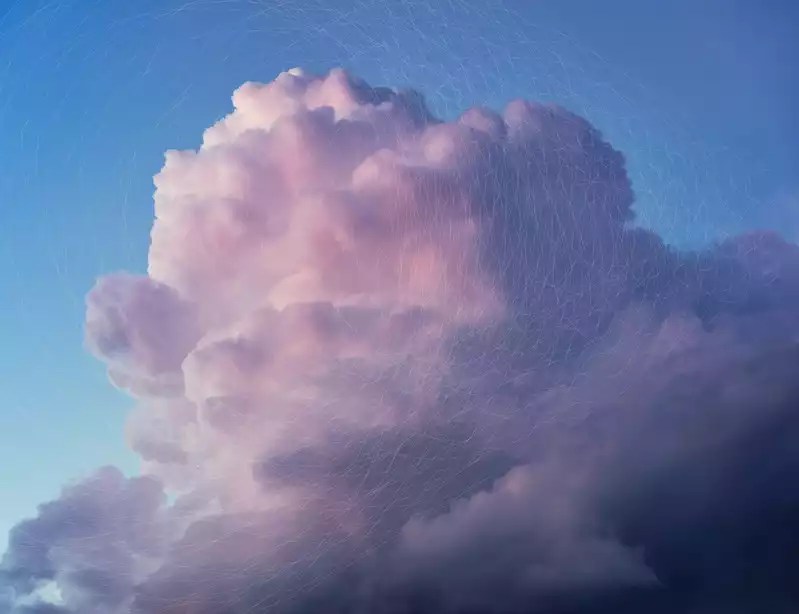
Olafur Elliason, ‘The Weather Project’, Installation, (2003), Tate Modern. Trevor Paglen, ‘Cloud #246, Hough Circle Formation’, Dye Sublimation on . . .Aluminium Print, (2019).
Vija Celmins has been a significant influence on my work and thinking in this unit. Her mezzotint series of starry skies achieves an extraordinary, almost photographic stillness, as evidenced in the beautiful image below. [xiii] Though Celmins depicts starry skies rather than clouds, I believe that her process reflects my own through her ideas of absence, repetition, meditation, and a sense of quiet mourning. Demos states that this meditative repetition that Celmins employs “materialises absence through process.” (Demos (2004)[xiv] Every mezzotint outcome thus becomes an exercise in compartmentalisation, a “working through”. This notion of artwork as a reparative act is one that is especially important to me. Hanna Segal, in her endlessly insightful book ‘Dream, Phantasy and Art’, excellently sums this up: “the work of art is… an expression of this working through.” (Segal, 2015)[xv]. I am interested in this idea of creating artwork as a proxy for emotion —or, as I mentioned previously, a vessel. The Swedish idea of the ‘Kanslöbild’ is a crucial notion for me presently. The ‘Kanslöbild’ refers to the ’emotional image’, or the ‘feeling picture’. The Kanslöbild encapsulates this idea of the artwork as a container for emotion. The crux of the Kanslöbild is that it does not attempt to suggest expressing emotion through the subject matter being depicted in the image; it is instead a physical representation of the emotion itself in pictorial form. Segal’s book similarly supports this notion of artwork being able to contain and express these complex emotions when words and normal means of communication fail, “when internal objects are felt in that way they can be projected into the external world” (Segal, 2015)[xvi], and this appears to be a profoundly human notion, beginning in childhood, “every infant tries to deal with his pains and needs by projecting them into an object.” (Segal, 2015)[xvii]. I believe that in my work, this is definitely evident; the purpose of every image I make is a response to this idea of ‘working through’, it is an attempt at the expulsion of these ideas that emerge from a preverbal place. This idea is further supported by Patricia Townsend in her book on the Creative Process, she talks of a comfort that “here in the outer world [is] a perceptual form that [chimes] with the inner.” (Townsend, 2019)[xviii] Townsend’s words here solidify my experience of working these plates within my studio practice, a concrete sense of relief and ‘expulsion’ when I am successfully able to execute a visual form that is able to externalise an inner emotional turmoil. As I discussed in my critique of some of John Constable’s more truthful images, the clouds that I create are not intended to be facsimile representations of actual meteorological forms, but instead as forms that ‘chime’ with that internal state of mourning and remembrance.

The Mezzotint is integral to my work and thinking as a process. Whether the plate is traditionally rocked, or is ground down using carborundum, in my case, means that every image is born from an aggressive and violent act, mirroring the event that causes the need for the reparative work of mourning, in my case, echoing the death of my dad. The medium rests upon darkness, and the slow, methodical, almost alchemical transfiguration of this darkness into light. This process thus relates to the psychic and internalised work of mourning, cutting and digging through the darkness in order to exhume small slivers of respite from the black void.
In conclusion, I have developed my research and practice not just to represent grief, but as an exercise in ‘working through’ it. The cloud form within my work, as a recurring motif, allows for the work of mourning and reflection to take place. Through these depictions of clouds, I make these internal turmoils concrete and am able to convey these ideas and notions to my audience, making visible the formless and abstract complexities of emotion. Thus, the finished mezzotint pieces become not mere aesthetic representations of grief, but rather the residue of psychic work. Throughout the unit, the writings of Townsend, Segal, Proust and Bachelard have served as invaluable reference points for the nature of the cloud as a vessel for grief, memory and mourning, as well as for the notion of creating as a healing and reparative act. Through a focus on these ephemeral floating vessels, I aim to turn my ideas of absence and loss into a reparative work that enacts the slow, methodical work of remembrance.
[i] Maleuvre, D. The Horizon: a history of our infinite Longing. (P.2)Berkeley: University of California Press.
[ii] Bachelard, G., Farrell, E.R. and C Frederick Farrell (2011). Air and dreams : an essay on the imagination of movements / monograph. (p.170) Dallas: Dallas Institute Publications, Dallas Institute Of Humanities And Culture.
[iii] Constable, J. (1821), Cloud Study: Horizon of Trees [oil on board], R.A
[iv] Turner, J.M.W, (1823), Shields, on the River Tyne, [Mezzotint on paper], R.A
[v] Brooke, R. (2019). The Collected Poems of Rupert Brooke. (p.97), BoD – Books on Demand,
[vi] Larkin, P. (2012). The Less Deceived. (pp.45), Faber & Faber,
[vii] Zambreno, K. (2017). Book of mutter. (p.55), South Pasadena, Ca: Semiotext(E), Cambridge, Massachusetts; London, England,
[viii] Harley, T. (2018). Weather and behaviour – The British Psychological Society. [online] http://www.bps.org.uk. Available at: https://www.bps.org.uk/psychologist/weather-and-behaviour [Accessed 9 Jul. 2025].
[ix] Proust, M. and Scott-Moncrieff, C.K. (2016). Remembrance of things past. Volume 3, The captive ; The sweet cheat gone ; Time regained. (p.940), London: Penguin Classics.
[x] Stewart, S. (1993). On Longing: narratives of the miniature, the gigantic, the souvenir, the collection. (p.135) Durham, N.C.: Duke University Press.
[xi] Eliasson, O. (2003) The Weather Project [Installation], Tate Modern.
[xii] Paglen, T. (2019), Cloud #246, Hough Circle Formation. [Dye Sublimation Print on Aluminium]
[xiii] Celmins, V. (1985) Night Sky (the view). [Mezzotint on paper]
[xiv] Demos, T. J. (2004) ‘Vija Celmins and the Dialectics of Stillness’, (pp. 73–96.) October.
[xv] Segal, H. (2015). Dream, phantasy and art. (p.80) London: Routledge.
[xvi] Segal, H. (2015). Dream, phantasy and art. (p.47) London: Routledge.
[xvii] Segal, H. (2015). Dream, phantasy and art. (p.50) London: Routledge.
[xviii] Townsend, P. (2019). Creative States of Mind. (p.8) Routledge.
 Ollie Norris